Layering Curtains: Style Meets Function
How to layer sheers with drapes — double rods, fabric pairings, and light control by hour — plus when a single layer honestly does the job.
By The Jenua Workroom · Updated September 30, 2026 · 6 min read
A single curtain is a compromise by definition: open or closed, light or dark, seen or private. Layering — most classically a sheer under a heavier drape — removes the compromise by giving a window modes. It's also, not coincidentally, how nearly every professionally designed room you've admired handles its windows. Here's the mechanics, the pairings that work, and the honest cases where one layer is plenty.
What layering actually buys you
Light by the hour. Sheers closed and drapes open at noon: the room is bright but the glare is gone and the street can't see in. Both closed at night: privacy and darkness. Both open on a gray day: maximum light. That's four useful states from one window; a single panel gives you two.
Real insulation. Two fabric layers trap two air gaps. In winter, closed sheer + closed lined drape outperforms either alone by a wide margin; in summer the sheer alone bounces heat while keeping the room from going dark. (The physics is the same still-air logic covered in curtains vs. blinds.)
Depth. A layered window reads dimensional even when nothing is closed — the sheer softens the glass, the drape frames the composition. It's the visual difference between a dressed window and a covered one.
The hardware, plainly
- Double rod. Two rods, shared brackets, inner rod slightly shallower. Sheer inside, drape outside. Fits almost anywhere a single rod fits; needs about an extra inch of wall clearance.
- Double track. The ceiling-mounted version for pinch-pleat panels — cleanest sightline, best for full walls of glass and room dividers.
- Blind-plus-curtain. A fitted roller, roman, or cellular shade inside the recess plays the inner layer; a normal single rod carries the fabric outside. Often the cheapest path, and the most precise daytime control.
- No-new-hardware tricks. Tension rod in the recess for the sheer; or double-cup hooks that hang a stationary sheer behind an operating drape on one rod. Both work; both trade some glide.
Mounting rules don't change from a single layer — high and wide still wins (hanging guide) — but add a couple of extra inches of side extension so both stacks clear the glass when open.
Pairings that work
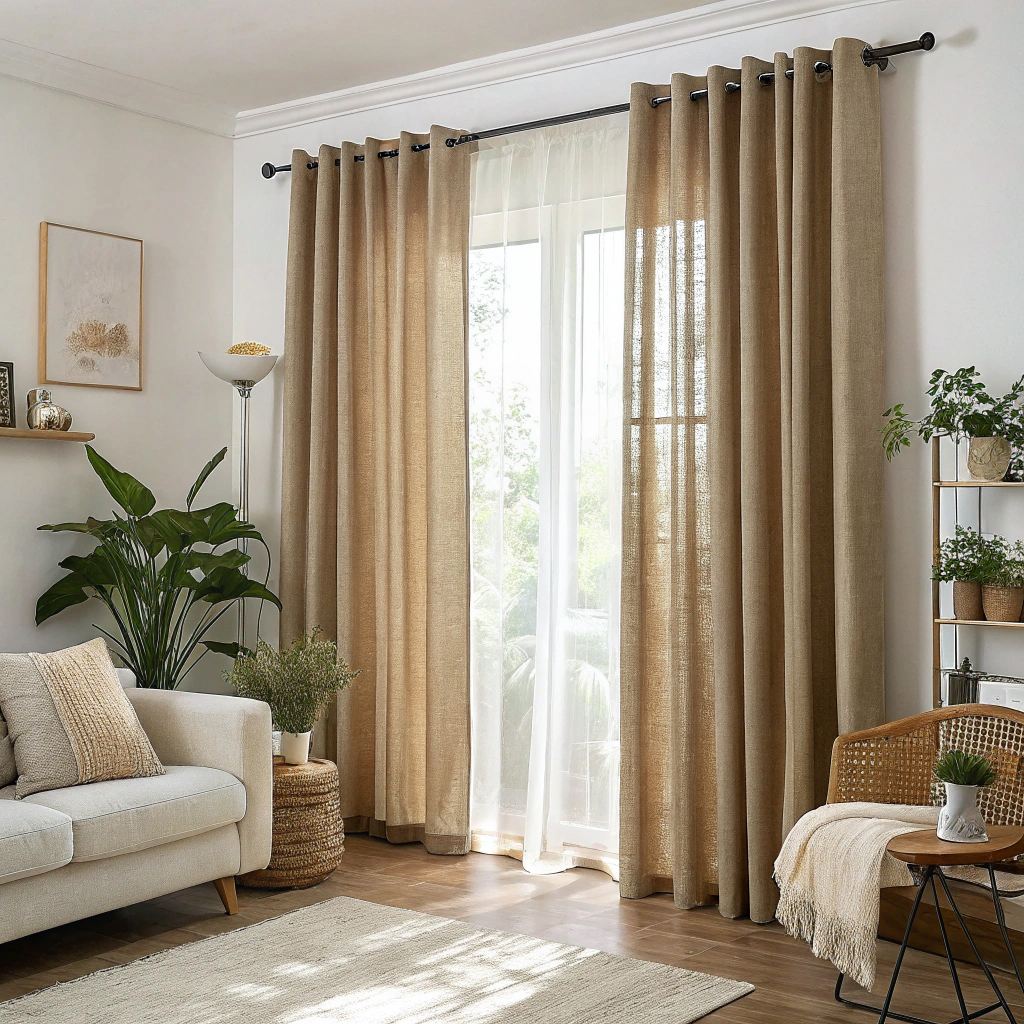 Sheer + linen: the everyday classic.
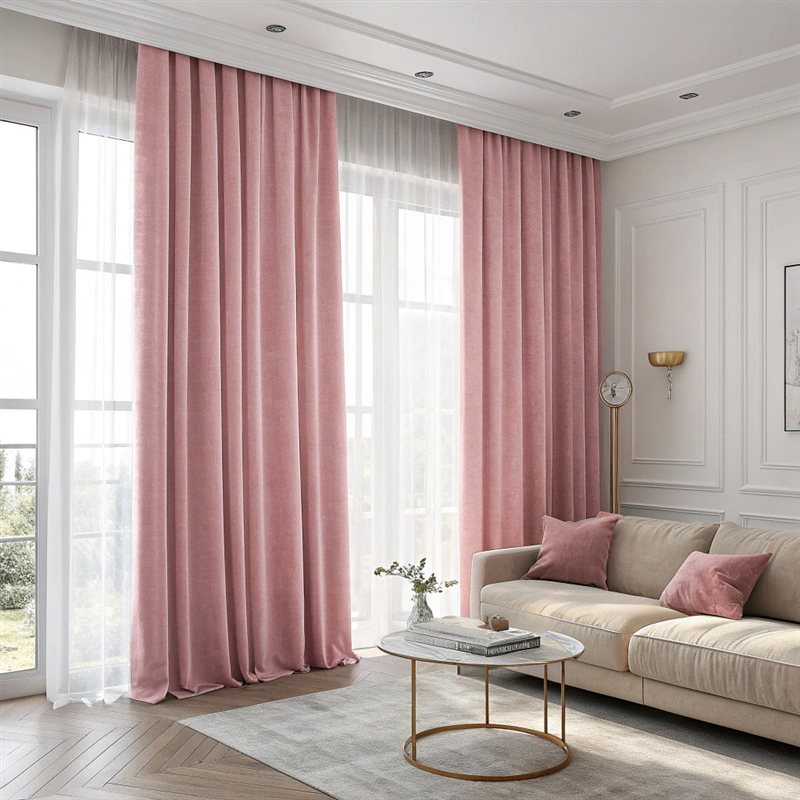 Sheer + velvet: soft light under rich color.
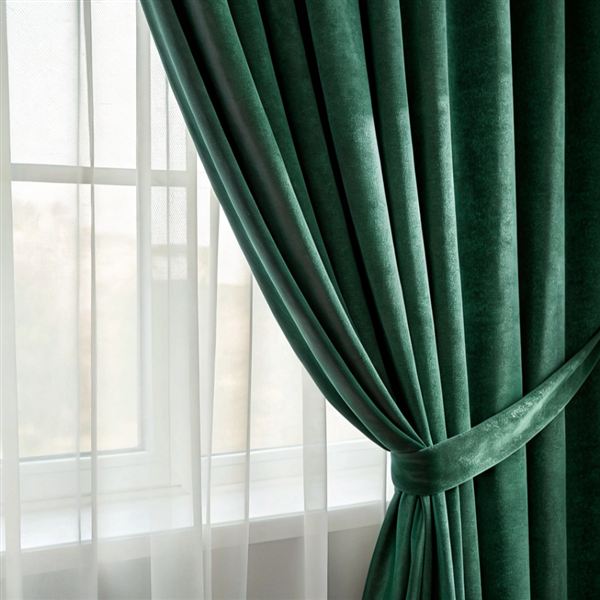 Tied back, the sheer keeps the glass soft.
Sheer + linen — the everyday classic. White sheer under flax or natural linen: daytime glow, evening softness, zero drama. If a home only layers one room, it's usually the living room, and it's usually this.
Sheer + blackout — the bedroom workhorse. All-day privacy and light from the sheer; genuine darkness at night from the blackout layer. This pairing is why "blackout curtains make rooms cave-like" is a myth — the cave only exists when blackout is the only layer.
Sheer + velvet — the formal room. Gauze under velvet's weight is a high-contrast texture pairing that makes both fabrics look more expensive. Give velvet the fuller stack and let the sheer be the quiet layer.
Linen + linen — tone on tone. Two opacities of the same fiber (a loose-weave inner, a lined outer) for schemes that want layering without visible contrast. Subtle, and very hard to get wrong.
Proportions: the part people get wrong
- Fullness: the sheer is the fuller layer — 2× to 2.5× rod width, against 1.5–2× for the outer drape (the options depend on the header; the header style guide lists them). A skimpy sheer under a generous drape looks like a lining that escaped; the reverse looks intentional and light.
- Length: both layers to the same finish — floats to the same half-inch, per the length guide. A sheer that hovers while the drape puddles reads as an error. The exception is a deliberate contrast: sheer floating, velvet puddling, in an unapologetically romantic room.
- Header: the layers don't need matching headers — back-tab sheer under pinch-pleat drape is a classic — but keep the outer layer the more structured of the two.
A worked bedroom
East-facing bedroom with a 66-inch-wide window: double rod mounted 10 inches above the frame, extended 10 inches per side (rod length 86 in). For each layer you enter the same 86-inch rod width and choose a split pair — we work out the fabric. Inner: white sheer, grommet, 2.5× fullness. Outer: flax linen with blackout lining, pinch pleat (sewn at 2.5× as standard) — the more structured layer on the outside. Both float ½ inch. Morning: sheers closed, linen open — soft sunrise, no direct beam. Night: both closed — dark enough to sleep past dawn, and the twin air gaps take the edge off a cold window.
Beyond two layers
A third layer — usually a fitted blackout roller inside the recess, under sheer-plus-drape — belongs in exactly two rooms: bedrooms of genuinely light-sensitive sleepers (the roller seals the recess; the fabric layers do atmosphere) and street-level windows that need daytime privacy, evening softness, and nighttime light control. Anywhere else, three layers is hardware clutter.
Valances and cornices are the traditional "top layer." Treat them as an aesthetic commitment rather than a functional one: a straight, tailored cornice can hide utilitarian hardware and finish a formal scheme, but it locks the rod height permanently and lowers the perceived window top — the exact opposite of the height tricks in the hanging guide. If in doubt, skip the top treatment; a clean rod ages better.
Seasonal swaps are layering across time instead of depth: sheers-only through summer, adding or switching to the lined outer layer as heating season starts. Panels store flat in a pillowcase on a closet shelf, and the swap takes minutes with grommet or back-tab headers. A simple pattern that works: white sheers year-round, natural linen October–April, nothing else — the room changes season on one set of brackets.
When not to layer
- Kitchens and baths — one washable layer (or none — see the case for blinds there) beats two fabric layers collecting grease or moisture.
- Deep recesses and shallow walls — if a double rod would push fabric into the walkway, use the blind-plus-curtain pattern instead.
- Rooms with one job — a home theater needs blackout, full stop; a sunroom needs sheers, full stop. Layering earns its hardware only where light needs differ across the day.
- Tight budgets, big windows — a good single lined drape beats two mediocre layers. Layer later; the double bracket retrofits in minutes.
The shopping list, consolidated
To layer one window you need, in total: a double rod or double track sized to your extended width (with a center support past 60 inches); the inner sheer at 2–2.5× fullness; the outer drape at 1.5–2× with your chosen lining; and ten extra minutes on the ladder. Order both fabric layers to the same finished length unless you're making the deliberate float-over-puddle contrast, and hang the outer layer first — it's easier to level the sheer against a hung drape than the reverse. Everything else is the same measuring you'd do for one layer, run twice.
Layering is the rare upgrade that's both cosmetic and mechanical — the room looks softer and works harder. Start with the sheer question (does daylight need taming?) and the pairing picks itself.
Frequently Asked Questions
What is the point of layering curtains?
Layering gives one window multiple light modes: a sheer inner layer for soft daylight and daytime privacy, and an opaque outer layer for evening privacy, darkness, and insulation. One layer can't do both jobs — layering is how a window works at 10 a.m. and 10 p.m.
What hardware do you need for layered curtains?
A double rod — two parallel rods on shared brackets, the inner one slightly recessed — is the standard. Alternatives: a double-track for pleated panels, or a fitted blind inside the recess playing the inner role under a single conventional rod outside it.
Do layered curtains work on small windows?
Yes, if you mount wide and high so the stacked fabric lands on the wall rather than the glass. Extend the rod about 10 inches per side (6–15 works) and use moderate fullness on the outer layer. On a truly tiny window, a blackout roller inside the recess plus one curtain layer outside is the lighter-handed answer.
Should layered curtains be the same color?
The reliable formula is tonal, not identical: a white or ivory sheer inside, and an outer drape a few shades deeper in the same temperature family — ivory under flax, white under sage. High-contrast pairs can work but demand commitment; order swatches of both layers together and judge them touching.
Can you layer two sets of curtains without a double rod?
Yes: hang the sheer from a cheap tension rod inside the recess with the main rod outside; use double-cup ring hooks that carry both panels on one rod (fine for stationary sheers); or let a fitted shade play the inner layer. Each trick trades a little glide for simpler hardware.
Keep Exploring
- Sheer CurtainsAiry sheers that soften sunlight and give rooms a light, layered feel.
- Blackout CurtainsFull light control and better sleep, without giving up a tailored, elegant look.
- White Sheer Curtains, Made to Measure
- White Blackout Curtains: Bright Room, Dark Nights
- Curtains vs. Drapes vs. BlindsAn honest comparison of curtains, drapes, blinds, and shades — cost, light contr…
- Curtain Hanging Styles: Height, Width & Hardware Done RightWhere to mount the rod, how far to extend it, inside vs. outside mounts, and the…
- Curtain Fabric Guide: Linen, Velvet, Blackout, Sheer & Semi-SheerHow linen, velvet, blackout, sheer and semi-sheer curtains actually behave — lig…