
How to Measure for Curtains
Measure for made-to-measure curtains in four steps — rod position, rod width, fullness and length — with a worked example and the mistakes to avoid.
By The Jenua Workroom · Updated September 29, 2026 · 7 min read
Getting curtain measurements right takes five minutes, a steel tape measure, and knowing which numbers actually matter. This guide walks you through all of them — where the rod goes, rod width, fullness and length — with a worked example you can copy for your own windows.
One rule before anything else: measure the rod, not the window. Every measurement below starts from where your rod is (or will be), because that's where the fabric lives.
What you'll need
- A steel tape measure — cloth sewing tapes stretch and can throw you off by half an inch over a wide window
- A pencil and a step stool
- A second pair of hands for windows wider than about 6 feet (sagging tape reads long)
Measure in inches or centimeters — our configurator takes both and converts between them without losing your numbers.
Step 1: Position the rod (or measure the one you have)
If your rod is already up, skip to Step 2. If not, decide its position first — it changes both of your key measurements.
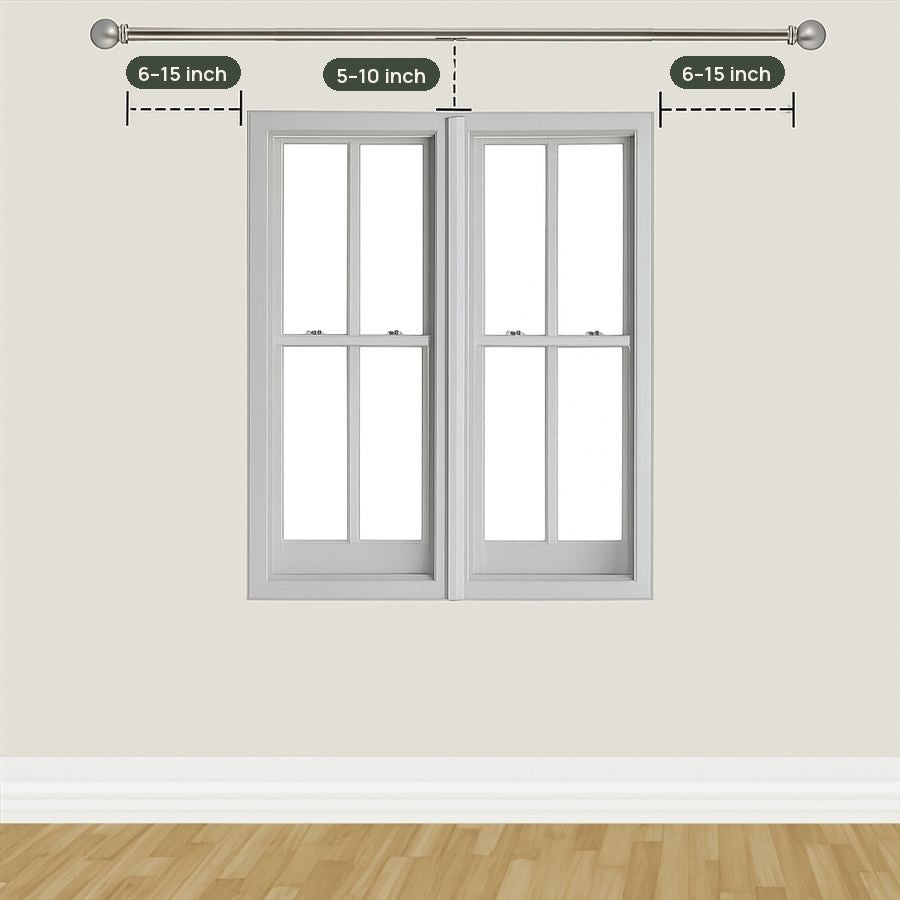
- Width: extend the rod 6–15 inches past the frame on each side — we suggest 10. Open curtains then stack against the wall instead of blocking glass, which keeps the window looking wider and the room brighter. Go toward 15 for full, heavy curtains or a window that gets full sun.
- Height: mount the rod 5–10 inches above the window frame. Higher makes the window read taller — with a lot of wall above the window, hanging the rod closer to the ceiling often looks better.
This part is partly taste, and it depends on your window and ceiling. If you're unsure, our free design service will suggest a position from a photo of your room.
Step 2: Measure rod width
Measure the rod itself — end to end, not counting the finials (the decorative end caps, which fabric never crosses).
Write this number down; it's the width you'll enter. For bay windows or corner rods, measure each straight section separately and treat each as its own "rod."
Step 3: Choose your fullness — we do the math
Fabric exactly as wide as your rod hangs almost flat. What makes custom curtains look custom is fullness: sewing the curtains from more fabric than the rod is wide, so they fall in soft, continuous folds even when closed. 2× means twice the rod width in fabric.

You don't calculate this yourself. Enter your rod width as-is, pick a fullness in the configurator, and we work out the fabric. The options depend on the header style:
- Pinch and euro pleats — pleats only show their character with more than 2×, so we sew them at 2.5× as standard.
- Grommet — 2× is ideal; choose 2.5× for a fuller look.
- Rod pocket — 1.5×, 2× or 2.5×; sheers look best at 2.5×.
- Back tab, tab top and flat panel — 1×, 1.5× or 2×.
- Ripple fold — 2× or 2.5×.
The header style guide shows every one of these side by side.
Worked example
Say your rod measures 60 inches end to end, and you want a pair of grommet curtains in linen:
- Rod width: enter 60 inches — the rod, as measured
- Panels: choose split pair — two curtains that meet in the middle
- Fullness: choose 2× — we sew the pair from 120 inches of fabric, 60 per curtain
That's it: no dividing, no rounding. Each curtain, when open, stacks neatly to one side; closed, the pair meets in the middle with its folds intact.
Step 4: Measure the length
Measure from the top of the rod straight down to where you want the fabric to end — in at least two places along the rod, because floors and window frames are rarely perfectly level. Use the smaller number. We sew exactly the length you enter.
For floor length, measure to the floor, then choose your finish:
 A small gap: take off as much as you like — ½ inch is the tailored classic.
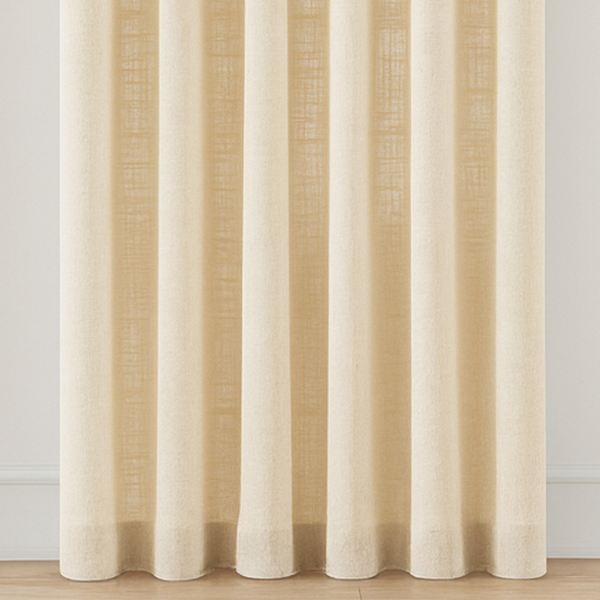 Kiss the floor: enter the number as measured.
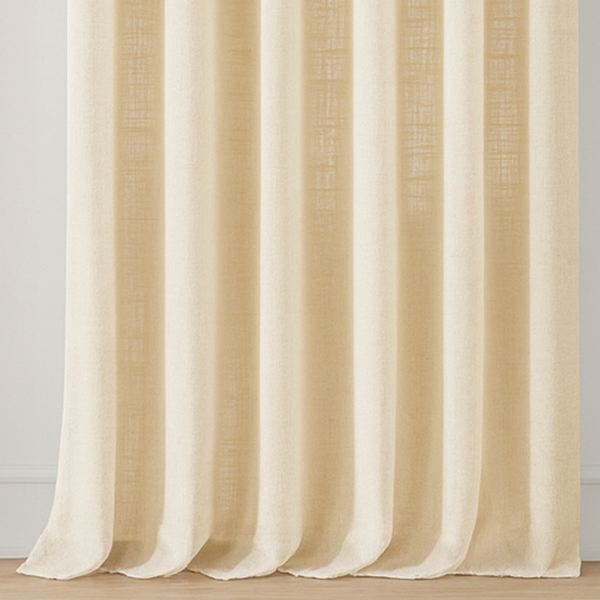 Puddling: add 1–2 inches so the hem pools softly.
Sill length — to the sill or ½ inch below it — is the right call above radiators, kitchen sinks and in bathrooms, and honestly the only practical call there. Everywhere else, floor length reads more finished.
Special cases
Radiators and baseboard heaters. Floor-length fabric draped over a radiator blocks heat and, with some fabrics, is a scorch risk. Measure to 1 inch above the radiator, or switch that window to sill length.
Sliding doors. Treat the door like a wide window: rod 5–10 inches above the frame, extended generously on the side where the door opens so stacked panels never block the walkway. Leave a small gap above the floor — ½–¾ inch — so daily traffic doesn't drag the hem.
Inside-mount situations. If you must mount inside a deep window recess (common with concrete lintels), measure the recess width at top, middle and bottom, use the smallest number, and expect to give up fullness — 1× or 1.5× is realistic inside a frame. Where you have any choice, outside-mount looks better and blocks light leaks at the edges.
No rod yet, and renting? Tension rods work inside recesses without drilling; measure the recess as above. For everything else, a normal rod with two brackets leaves holes smaller than a picture hook's.
Bay windows and corners, worked through
Angled windows scare people off custom orders unnecessarily. The method: treat each straight run of rod as its own window. A typical three-panel bay with a 40-inch center rod and two 24-inch angled returns is three orders — enter 40 inches for the center and 24 for each side, choosing the same fullness for all three, and one shared length (taken at the bay's lowest floor point, since bays settle more than flat walls). Specialized bay rods with corner elbows carry pinch-pleat panels around the bends; grommets can't turn corners, so header choice matters more here than anywhere else. If your bay has equal 30/30/30 runs, resist the urge to order one giant width and "bend" it — fabric bunches at every elbow and never sits right.
Common mistakes, quickly
- Measuring the window, not the rod. The #1 source of skimpy-looking curtains.
- Entering a panel width instead of the rod width. Enter the rod as measured — the fullness you choose adds the fabric for the folds.
- Using one length for the whole room. Floors slope; measure per window.
- Measuring over trim or hardware. Keep the tape flat against the wall.
- Eyeballing the length. Measure to the nearest ¼ inch at two or three points and use the smallest.
Ready to order
That's the whole job: rod width, fullness, and the length to your chosen finish. Enter the numbers in any product's configurator and it checks your size as you type.
If you'd rather have a second pair of eyes on your numbers first, send them through our free design service — a designer will sanity-check the math and suggest fullness for your fabric within a business day. And if the finished panels somehow still don't fit, the remake guarantee has you covered.
Frequently Asked Questions
Do I measure the window or the rod for curtains?
Measure the rod, not the window. Curtain width is based on the rod — the length between the decorative end caps (finials) — because the rod, not the glass, defines where fabric starts and stops. If you haven't mounted a rod yet, plan its position first: 5–10 inches above the frame and 6–15 inches past each side (we suggest 10), then measure that planned span.
How much wider than the window should curtains be?
You don't need to work it out. Enter your rod width as-is in the configurator and choose a fullness — 2× means the curtains are sewn from twice the rod width in fabric. We do the fabric math, so never enter a panel width or a fabric width yourself.
Should curtains touch the floor?
For most rooms, yes. Measure from the top of the rod to the floor — we sew exactly the length you enter. Want a small gap above the floor? Take off as much as you like. Want the hem to pool softly? Add 1–2 inches. Stop at the sill instead for windows above radiators, kitchen counters or in high-traffic kids' rooms.
What if I measure wrong and my custom curtains don't fit?
Our remake guarantee covers you: if we sewed your panels wrong we remake them free, and if the measurement was off we remake them at 40% off. Even so, measure twice with a steel tape — most errors come from cloth tapes stretching or reading the wrong side of the hook.
Do I need different measurements for grommet vs. rod pocket curtains?
No — measure the same way for every header: rod width, and length from the top of the rod. Then choose your header style in the configurator. Grommet panels sit slightly higher on the rod than pleated or rod pocket panels, so if the exact hem position matters, our design team can check it for you.
Keep Exploring
- Linen CurtainsBreathable, softly textured linen that filters light beautifully and drapes with ease.
- Blackout CurtainsFull light control and better sleep, without giving up a tailored, elegant look.
- White Linen Curtains, Made to Measure
- White Blackout Curtains: Bright Room, Dark Nights
- Curtain Length & Drop Guide: Float, Kiss or Puddle?The curtain lengths we sew — sill, float, kiss the floor and puddle — with photo…
- Layering Curtains: Style Meets FunctionHow to layer sheers with drapes — double rods, fabric pairings, and light contro…
- Curtains vs. Drapes vs. BlindsAn honest comparison of curtains, drapes, blinds, and shades — cost, light contr…