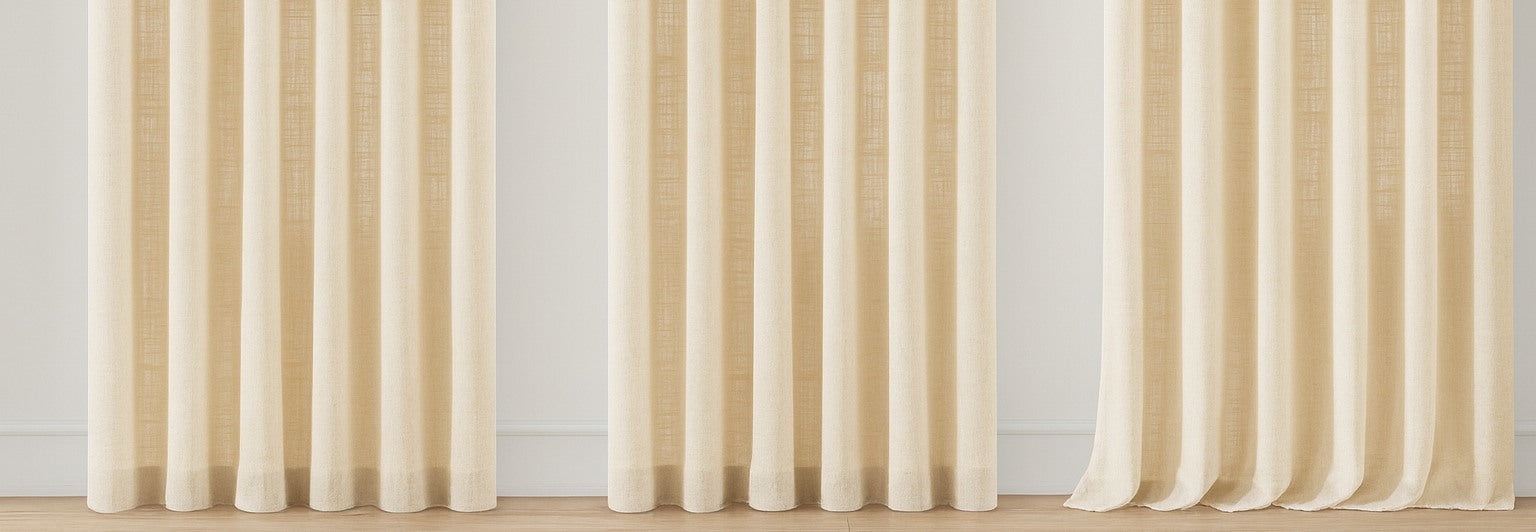
Curtain Length & Drop Guide: Float, Kiss or Puddle?
The curtain lengths we sew — sill, float, kiss the floor and puddle — with photos, the exact number to enter, room-by-room picks and the cases where each fails.
By The Jenua Workroom · Updated September 29, 2026 · 6 min read
On this page
- The lengths
- Float: the tailored default
- Kiss the floor: the clean line
- Puddle: relaxed on purpose
- Sill length: functional zones only
- Room-by-room quick answers
- Measuring for each length
- Worked example
- Header style and length
- Hem construction: what to look for
- Pets, kids, and robot vacuums: a quick decision tree
- If you're stuck
Length is where custom curtains earn their keep most visibly. Off-the-shelf panels come in 84, 95 and 108 inches; windows and ceilings don't. The gap between "close enough" and "cut for this exact wall" is usually one to three inches — and it's precisely those inches that decide whether a room looks finished.
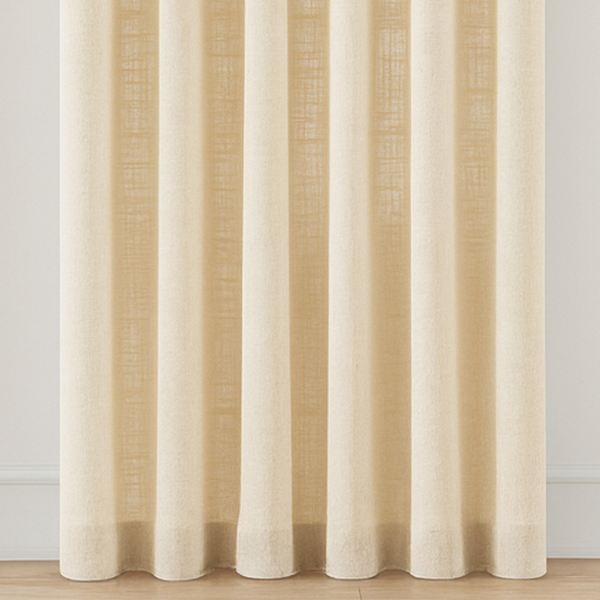
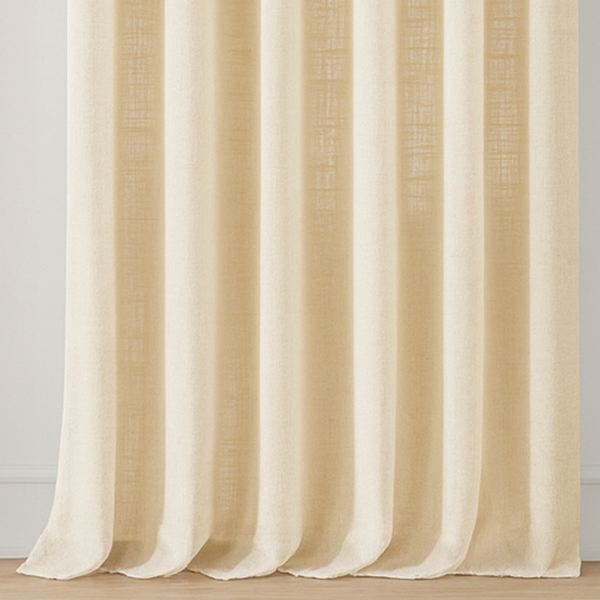
Every length starts from one measurement — top of the rod to the floor — and we sew exactly the length you enter. Here's what each finish looks like, the number to enter, and where each one fails.

The lengths
Float: the tailored default
Enter: rod-to-floor minus ½ inch.
Close enough to read as touching, high enough that the panel hangs dead straight, never buckles on an uneven board, and clears a vacuum or robot mop untouched. Works with every fabric and header, needs zero maintenance, and photographs perfectly. Want a bigger gap? Take off as much as you like.
Where it fails: rarely — its only real cost is a certain crispness. In a soft, romantic scheme, a float can read slightly too exact, like a freshly pressed shirt at a beach wedding. That's the cue for a kiss or a puddle.
Kiss the floor: the clean line
Enter: rod-to-floor as measured.
The hem just meets the floor, so the curtain reads as one continuous line from rod to floor — no visible gap, no fabric on the ground. It's the most "finished" look for modern and transitional rooms.
Where it fails: very uneven floors. Where the floor dips the hem floats, and where it rises the hem touches down, so the difference shows. Measure at two or three points and use the smallest number; on a noticeably sloping floor, choose a float or a puddle instead.
Puddle: relaxed on purpose
Enter: rod-to-floor plus 1–2 inches.
The extra length rests on the floor and folds softly, like suit trousers breaking on a shoe. It says the fabric was cut generously, not precisely — and it quietly forgives sloping floors (common in pre-1960s homes): the fold absorbs half-inch variations a float would expose. Two inches is our recommendation in linen.
Where it fails: high-traffic doorways (the fold catches feet and vacuum heads) and crisp minimalist schemes, where the softness reads as imprecision. It also needs occasional "dressing" — thirty seconds of arranging the fold after closing.
Going further: a deep puddle — 4–6 inches or more, pooling deliberately — is formal theater. In velvet or heavy linen, in a dining room or a bedroom with height to spare, it's unapologetically romantic. It also fails often: pets treat puddles as bedding, kids as tug toys, robot vacuums as prey, and in light fabrics the pool collapses into what looks like laundry. Choose it knowingly — formal room, heavy fabric, panels that rarely move.
Sill length: functional zones only
Enter: rod to the sill, or to ½ inch below it (below reads more finished, hiding the sill's shadow line).
The working choice above radiators, kitchen counters, bathroom fixtures and window seats — anywhere floor-length fabric would block heat, drag in water, or sit on a surface. In those rooms, sill length is correct and looks it.
Where it fails: everywhere else. On an ordinary living room or bedroom wall, sill-length panels chop the wall in half and read as a cost-saving. If nothing functional forces the short hem, go to the floor — curtain length follows the wall, not the window.
Room-by-room quick answers
| Room | First choice | Why |
|---|---|---|
| Living room | Kiss or float | Clean and tailored; a 1–2 in puddle if the scheme is relaxed |
| Bedroom | Float or kiss | Straight hang seals better with blackout lining |
| Dining room | Puddle | Low traffic, formality welcome — go deeper in velvet |
| Kitchen | Sill length or café | Grease, water and counters rule out floor length |
| Bathroom | Sill length | Moisture; consider a shade instead |
| Kids' room / nursery | Float | Nothing at floor level to grab; pairs with blackout |
| Home office | Float | On camera, crisp lines behave best |
Measuring for each length
All the lengths derive from one measurement: top of rod to floor, measured at two or three points along the rod (floors slope — use the smallest number, per the measuring guide). Then:
- Float: enter rod-to-floor minus ½ inch.
- Kiss: enter rod-to-floor as measured.
- Puddle: enter rod-to-floor plus 1–2 inches (4–6 for a deep, formal puddle).
- Sill: measure rod to the sill, or ½ inch below it, and enter that instead.
Worked example
Rod mounted at 90 inches; floor measurements along the rod read 90, 89.75 and 89.9 inches — take 89.75.
- Float → enter 89.25 in
- Kiss → enter 89.75 in
- Puddle → enter 91.75 in (2 inches)
Same window, three different rooms' worth of character, decided by a single number. Rather not do the math? Design Your Curtains and the curtain size calculator both work out the length for float, kiss and puddle.
Header style and length
A grommet panel hangs from the grommets' top edge, slightly above the rod's centerline; a pinch pleat hangs from hooks near the rod's top; rod pockets sit over the rod. For every header, measure the same way — from the top of the rod — and choose your header style in the configurator. If the exact hem position matters, say a float over a threshold, our design team can check your numbers for your header before you order.
Hem construction: what to look for
Length decisions land in the hem, and hem construction is half of why custom panels hang differently. Three things to look for in any made-to-measure curtain:
- Depth. A generous double-fold bottom hem adds weight exactly where a panel needs it: at the bottom, pulling everything straight. Skimpy single-fold hems are the first tell of a cheap panel and the first place it ripples.
- Weights. Small corner weights stop hems from flaring at the edges — especially useful in light linen.
- A clean face. The bottom hem shouldn't show a heavy topstitch line across the front. It's a small thing you stop noticing in a day and would notice immediately if it were there.
None of this changes the number you enter at ordering — but it's what keeps a float a float, wash after wash, instead of creeping into an accidental high-water hem.
Pets, kids, and robot vacuums: a quick decision tree
- Robot vacuum runs at night, unattended → float, nothing longer, in every room it can reach. Puddles end up ingested; it's a matter of when.
- Cats → floats everywhere; a puddle is a cat bed you paid drapery prices for. Cats mostly ignore hanging fabric but colonize pooled fabric within the week.
- Dogs that shed → float or kiss; anything pooling collects hair at a rate that outpaces any cleaning schedule.
- Crawling baby → float, plus check that tiebacks and cords (if any) sit above reach; length itself is rarely the hazard, dangling hardware is.
If you're stuck
Float. It's the answer for most windows, it never embarrasses you, and it keeps future options open — a float can become a kiss later by lowering the rod half an inch, but a sill-length panel can never become floor length.
And because every Jenua panel is covered by the remake guarantee, a length that arrives wrong gets remade, not returned — free if the mistake is ours, at 40% off if the measurement was off. Measure twice anyway.
Frequently Asked Questions
Should curtains touch the floor or hover above it?
Either works — it's a style choice. A float hovers about half an inch above the floor: tailored, dead straight and easy to clean around. A kiss just touches the floor for a clean, finished line. For a softer look, add 1–2 inches so the hem pools gently. We sew exactly the length you enter, so measure to the floor and adjust from there.
What is a puddled curtain?
A curtain cut longer than the rod-to-floor measurement so the hem rests on the floor. Adding 1–2 inches gives a soft pool that reads relaxed and generous and forgives small floor slopes; 4 inches or more is a deliberate, formal puddle for heavy fabric in low-traffic rooms.
Are puddled curtains outdated?
No — but a deep puddle has become a deliberate, formal gesture rather than a default. A 4–6 inch puddle in velvet or heavy linen suits romantic and traditional rooms beautifully. It's the wrong call with pets, kids, robot vacuums, or any door that sweeps the fabric.
How much shorter than the floor should curtains be for a radiator?
End the hem about 1 inch above the radiator's top surface, or choose sill length (half an inch below the sill) for a cleaner line. Full-length fabric over a working radiator blocks heat and, with synthetics, can be a scorch risk.
What length should café curtains be?
Café curtains cover the lower half — or lower two-thirds — of a window, mounted so the top edge sits at a natural sightline, typically 40–48 inches from the floor in kitchens. They're measured from their own rod to the sill, not to the floor.
Keep Exploring
- Linen CurtainsBreathable, softly textured linen that filters light beautifully and drapes with ease.
- Velvet CurtainsRich, weighty velvet that insulates, quiets a room, and reads unmistakably luxe.
- White Linen Curtains, Made to Measure
- Emerald Velvet Curtains, Made to Measure
- How to Measure for CurtainsMeasure for made-to-measure curtains in four steps — rod position, rod width, fu…
- Layering Curtains: Style Meets FunctionHow to layer sheers with drapes — double rods, fabric pairings, and light contro…
- Curtains vs. Drapes vs. BlindsAn honest comparison of curtains, drapes, blinds, and shades — cost, light contr…